DOKIO 300W Foldable Solar Kit: Raw Power for Heavy Field Rigs
Julia Ellery 9 Nov 2026 9 min read ASIN B07VL4LVF1
This product against the Tools & Outdoors median
| Figure | This product | Category median | Where it sits |
|---|---|---|---|
| Our score Our score, out of 10. | 9.6/10 | 9.0/10 n=186 | 7% higher than the median |
| Spec fields published How many attributes the seller fills in on the listing. | 6 | 5.0 n=187 | 20% more than the median |
Medians are taken across the 187 published reviews in Tools & Outdoors; n on each row is how many of them publish that figure. The notch on every bar marks the median, so a fill reaching past the notch sits above it. Scores are out of 10, based on listed specifications and buyer feedback.

- Brand
- Dokio
- Our score
- 9.6/10
- Spec fields
- 6 attributes on the listing
As Amazon Associates, we earn from qualifying purchases. This means we may receive a small commission at no extra cost to you if you click through and make a purchase.
Powering high-drain portable electronics away from standard grid infrastructure requires substantial solar intake, and the DOKIO 300W Solar Panel is built to deliver serious raw output in a surprisingly packable footprint. Rated at 300 watts with an 18-volt output, this foldable monocrystalline array targets users who need to replenish sizable battery setups quickly to run demanding equipment like mobile workstations, streaming gear, and outdoor media systems. Instead of hauling heavy, rigid glass frames into the field, this kit provides high generation capability while maintaining a compact, transportable profile.
To get the most out of this setup, buyers must understand how its electrical characteristics interact with different battery systems and portable power stations. Its rated 16.67-amp current capacity introduces specific compatibility factors that can either maximize charging speeds or run into hardware bottlenecks depending on your receiver unit. This review breaks down the DOKIO 300W foldable solar panel kit, analyzing its physical design, included PWM charge controller, real-world cabling setup, and overall suitability for off-grid entertainment and mobile workstations.
What You Get With the DOKIO 300W Solar Panel 79 words
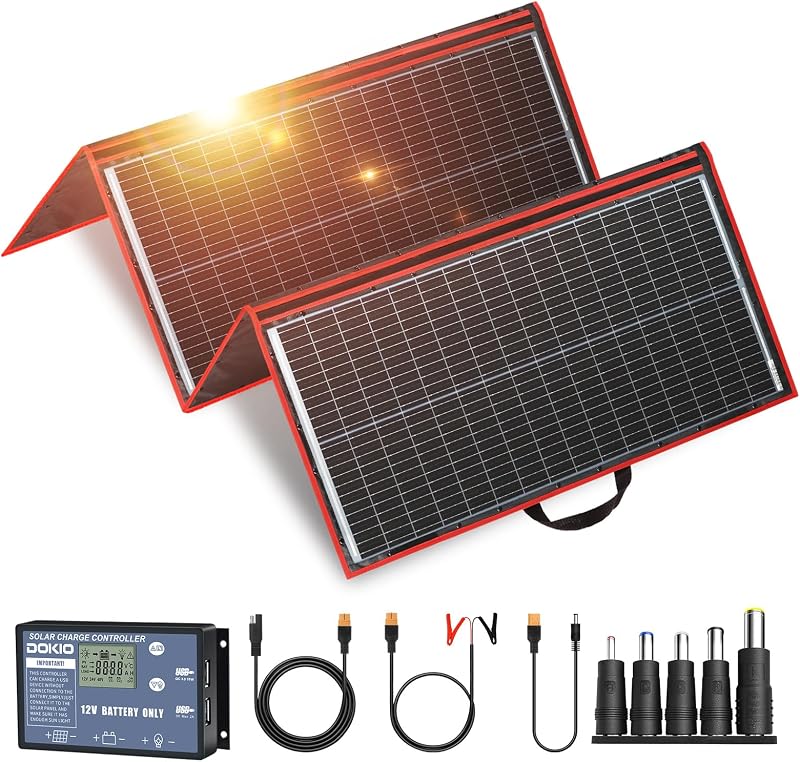
The package includes a comprehensive assortment of wiring harnesses and hardware designed to connect directly to individual 12V battery systems or central battery hubs right out of the box.
- DOKIO 300W foldable monocrystalline solar panel
- Standalone PWM charge controller with integrated dual USB ports
- 9.85-foot (3-meter) main connecting cable
- Wiring harness featuring SAE, XT60, and Alligator clip connectors
- DC barrel adapter set including DC5521, DC5525, DC35135, and DC6440 plugs
- Dedicated canvas storage bag
- User manual
Key Specifications 107 words
Understanding the dokio 300w portable solar panel specs is critical before matching it with sensitive electronic gear, as its high amperage output differs noticeably from conventional smaller panels.
Attribute Detail
- Maximum Power
- 300 watts
- Operating Voltage
- 18 volts
- Amperage Capacity
- 16.67 A
- DC Output Voltage
- 12 volts direct current
- Cell Material
- Monocrystalline silicon
- Item Weight
- 15.2 pounds
- Folded Dimensions
- 19.3 x 37.4 x 1.1 inches
- Charge Controller
- Standalone PWM with dual USB ports
- Included Cable Length
- 9.85 feet (3 meters)
- Model Number
- Solarpanel -300w
Fields the seller filled in on the Amazon listing (6)
- Color
- Black
- Size
- 300W 12V 20x38in
- Dimensions
- 37.4 x 19.3 x 1.1 Inches
- Weight
- 15.21 pounds
- Product Group
- Lawn & Patio
- Binding
- Tools & Home Improvement
Managing High Amperage and Station Input Limits 266 words
The defining electrical characteristic of this array is its architecture as a dokio 18v 16a solar panel. Producing 300 watts across an 18-volt baseline pushes the current capacity all the way to 16.67 amps. This low-voltage, high-amperage configuration is advantageous when feeding 12V deep-cycle batteries through a charge controller, as it moves abundant current into the bank without requiring complex high-voltage series setups. However, dokio 300w power station charging behaves very differently depending on the internal charging circuitry of your specific power unit.
Many compact and mid-sized portable power stations throttle incoming solar energy through an internal current limit, typically capped at 8, 10, or 12 amps. If you connect this 300W panel to a unit with an 18-volt input ceiling and a 10-amp current restriction, your charging station will max out at roughly 180 watts regardless of optimal midday sunshine. Connecting this array to smaller battery units like the arrowhead outdoor 296wh power station will result in the power station limiting the intake to protect its internal circuitry, leaving substantial solar output unused. This is an intentional safety feature of the receiver, not an equipment defect in the panel.
To experience the full dokio 300w output performance, users need an electrical receiver capable of processing up to 16.67 amps on an 18V circuit, or a standalone battery system managed through the included controller. High-capacity power stations with wider input parameters or dual-input channels can draw the full capability of the monocrystalline cells. Before purchasing, verify whether your target station limits incoming solar wattage to 100W or 200W, as doing so ensures your hardware can actually ingest the substantial current this array produces.
Power Demands for Off-Grid Media and Entertainment Rigs 211 words
Field production crews, digital nomads, and outdoor entertainment enthusiasts frequently run demanding gear that depletes standard portable batteries rapidly. Operating a high-performance laptop, external gaming monitor, cellular router, and camera charging bays can create a sustained power draw between 100 and 220 watts. Using a standard 100-watt panel under these circumstances guarantees net-negative energy flow, slowly draining the battery bank until the entertainment or editing session abruptly ends.
Deploying a portable solar panel for off grid gaming or remote broadcasting changes that operational dynamic. Generating upwards of 200 to 250 practical watts during prime sunlight hours allows an entertainment setup to offset continuous real-time discharge while feeding reserve power back into the primary battery. Paired with adequate capacity stations like the jackery solar generator 300 for auxiliary devices, the DOKIO array provides sufficient incoming energy to sustain extended multimedia playback, content editing, and device replenishment throughout daylight periods.
While massive stationary folding panels like the ecoflow 400 w solar panel provide even higher total wattage, they often introduce significant transport bulk and structural rigidity that complicate casual vehicle packing. The DOKIO strikes a functional balance for mobile power users by supplying genuine 300-watt potential while folding down into a slim profile that easily slides behind a vehicle seat or inside a gear bin alongside entertainment flight cases.
Physical Portability and Camping Durability 221 words
Transporting a dokio 300w solar panel for camping is straightforward thanks to its lightweight fabric-backed construction. Weighing in at 15.2 pounds and folding down to 19.3 by 37.4 by 1.1 inches, this panel avoids the extreme mass of aluminum-framed, glass-faced residential panels that offer similar wattage. The integrated carry handles and slim depth make it convenient for single-person setup, allowing users to position, reposition, and secure the array as the sun angles shift throughout the day.
The panel surface utilizes monocrystalline silicon cells treated for outdoor weather resistance, providing resilient performance across variable ambient temperatures. However, users should be mindful of the surrounding fabric enclosure. The listing notes that while the panel faces are weather-resistant, owners should avoid leaving the fabric case exposed to heavy rain or soaking conditions for days at a time to maximize product longevity. It serves exceptionally well as an active camp charger that is packed away when severe storms roll through.
Cable routing also benefits campsite layouts. The included 9.85-foot (3-meter) lead wire provides enough clearance to plant the panel in open, unshaded terrain while leaving your sensitive electronics, charge controller, and power stations tucked beneath an awning or shaded vehicle interior. Keeping lithium power stations out of direct midday heat is essential for preventing thermal throttling and maintaining charging efficiency, making this extended wire harness a valuable practical inclusion.
Setup and Connector Compatibility 210 words
Connecting the panel to various energy storage systems is supported by a comprehensive adapter bundle. The dokio 300w connector compatibility profile spans multiple industry standards, utilizing an SAE backbone paired with an XT60 adapter, traditional alligator clips for direct battery terminal clamping, and a suite of DC barrel plugs including DC5521, DC5525, DC35135, and DC6440. This enables immediate plug-and-play operation with numerous DIY battery banks and popular commercially built power hubs.
The heart of direct 12V battery charging is the standalone dokio 300w pwm charge controller. This detached module monitors power distribution and guards against reverse polarity, overcharging, overload conditions, and short circuits. Because the controller is external rather than permanently adhered to the back of the solar array, it can be swapped out or upgraded to a higher-end MPPT unit later if your system demands advanced maximum power point tracking algorithms.
The charge controller also features dual USB ports designed for low-draw device maintenance. When connected inline with an active 12V battery, these ports provide smooth, stable direct power to smartphones, portable handheld consoles, headlamps, and action cameras. While the USB ports can technically supply power directly from sunlight without a battery connected, the output current will fluctuate whenever passing clouds disrupt irradiance, making battery-buffered charging the recommended protocol.
DOKIO 300W Solar Panel Pros and Cons 48 words
Pros
Pros
- High 300-watt output rating
- Lightweight 15.2-pound folding design
- Separate upgradable PWM charge controller
- Generous 9.85-foot extension cable
- Includes XT60, SAE, and DC adapters
- Dual USB ports on controller
Cons
- 67A current exceeds small station limits
- Fabric casing requires shelter from rain
- Unregulated USB output without battery
Is the DOKIO 300W Solar Panel Worth It 205 words
Deciding if the dokio 300w worth it comes down to matching your equipment needs with its unique electrical layout. If you manage a dual-battery camper setup, an off-grid 12-volt leisure battery system, or an oversized power station with high current tolerances, this kit delivers exceptional charging wattage per pound of carrying weight. Its 15.2-pound construction eliminates the back-straining bulk traditionally associated with 300-watt solar generation, making it an excellent investment for mobile creators, remote workers, and extended campers.
Conversely, shoppers using entry-level power stations with rigid 8-amp or 10-amp solar input throttles will not experience the full benefit of its 16.67-amp potential. In those scenarios, much of the 300-watt capacity remains untapped behind the station’s internal limiters. For users who do not plan on upgrading to a higher-amperage power station or direct 12V leisure batteries, purchasing a 300-watt array may provide diminishing returns compared to smaller, right-sized options.
For outdoor enthusiasts who demand substantial power reserves to run multimedia setups, mobile production rigs, or extensive campsite lighting, the balance of high output, manageable weight, and bundled connection adapters makes this folding kit a highly capable field asset. It provides the heavy charging current necessary to keep large battery banks operating through days of off-grid entertainment.
Other Options to Consider 115 words
ZOUPW 100W Portable Solar Panel suits users operating compact power stations who do not need 300 watts of output and prefer an ultra-portable panel with 23.5% cell efficiency and IP67 water resistance for light camping.

Solar Battery Trickle Charger is built specifically for vehicle owners needing a 20-watt maintainer with an adjustable mount and smart MPPT controller to prevent battery drain on cars, boats, and RVs rather than charging portable power hubs.
200W Portable Solar Panel offers an intermediate power bracket with 24% efficiency ETFE construction, IP65 protection, MC4 outputs, and direct fast-charging USB-C and QC3.0 ports for users who want dedicated high-speed device charging without extra adapter cabling.

FAQ 260 words
Can the DOKIO 300W Solar Panel charge a power station without using the included PWM controller?
Yes. When connecting to a portable power station that already has a built-in solar charge controller (MPPT or PWM), you bypass the DOKIO external controller entirely. You run the panel directly into your power station using the appropriate included XT60 or DC barrel adapter cable.
Why does my power station show less than 300 watts of incoming solar power?
Solar panels operate based on environmental conditions and receiving hardware capabilities. The DOKIO panel outputs up to 16.67 amps at 18 volts, but many power stations restrict solar input amperage to 10 or 12 amps, which artificially caps intake. Real-world solar angle, atmospheric haze, and temperature also impact output.
Can I leave the DOKIO 300W panel outside in the rain?
The monocrystalline solar cells themselves feature weather-resistant surfaces, but the fabric case and external connections should not be left exposed to heavy rainfall or sustained moisture for days. To ensure longevity, bring the foldable panel under shelter during inclement weather.
Do the USB ports on the controller work without a battery attached?
The USB ports can deliver power in direct sunlight without a battery connected, but the electrical current will fluctuate as sunlight intensity shifts. For reliable and stable USB charging, the controller should be connected to a working 12V battery system.
What adapters are included for connecting to different devices?
The kit includes a main 9.85-foot cable alongside an SAE harness, an XT60 connector, standard alligator battery clips, and four distinct DC barrel connectors: DC5521, DC5525, DC35135, and DC6440.
The other listings this review names
-

-

SOLPERK Solar Panel Kit 20W 12V Solar Battery Charger Maintainer+Controller
9.6/10 Our score 5 spec fields
-


