Prusa CORE One Breakdown: Enclosed CoreXY Performance for Enthusiasts
Julia Ellery 25 Oct 2026 8 min read ASIN B0GH1LMV8R
This product against the Tools & Outdoors median
| Figure | This product | Category median | Where it sits |
|---|---|---|---|
| Our score Our score, out of 10. | 8.6/10 | 9.0/10 n=197 | 4% lower than the median |
| Spec fields published How many attributes the seller fills in on the listing. | 5 | 5.0 n=198 | level with the median |
Medians are taken across the 198 published reviews in Tools & Outdoors; n on each row is how many of them publish that figure. The notch on every bar marks the median, so a fill reaching past the notch sits above it. Scores are out of 10, based on listed specifications and buyer feedback.

- Brand
- Original Prusa
- Our score
- 8.6/10
- Spec fields
- 5 attributes on the listing
As Amazon Associates, we earn from qualifying purchases. This means we may receive a small commission at no extra cost to you if you click through and make a purchase.
Enthusiasts and makers aiming to produce custom components and rapid prototypes need a rigid, high-performance platform that delivers both velocity and dimensional accuracy. The Prusa CORE One targets this exact requirement by pairing an enclosed CoreXY architecture with active temperature management. If you are deciding whether this machine fits your workshop, it delivers a high-speed fabrication system built on an all-steel exoskeleton frame designed to maintain steady output during demanding print jobs. As the Original Prusa CORE One Plus iteration, this DIY kit version caters directly to builders who want complete mechanical familiarity with their hardware rather than an opaque appliance.
Before committing your workspace and build time, understanding the trade-offs between assembly effort, motion capabilities, and high-temperature material management is essential. The following guide investigates how the machine handles rapid toolhead motion, chamber thermals, firmware integration, and data privacy. We examine the complete kit contents, evaluate real-world engineering constraints, and compare its capabilities against other popular enclosed machines in the high-speed category.
What You Get With the Prusa CORE One 120 words

The DIY kit ships with all the necessary hardware components, structural framing, and electronics required to construct a fully enclosed CoreXY system from the ground up.
- All-steel exoskeleton frame engineered for high structural rigidity during rapid direction changes
- Fully enclosed build chamber capable of reaching internal temperatures up to 55°C
- Active thermal control system featuring an automatic top vent to regulate internal airflow
- Redesigned easy-flex loading system paired with a dedicated bayonet spool holder
- Comprehensive assembly package including 1:1 scale hardware templates and a step-by-step photographic manual
- Pre-terminated, completely solder-free wiring harness and electrical connectors
- Removable Wi-Fi module enabling 100 percent secure offline operation and local data processing
- Preloaded software profiles and native integration with the Printables model ecosystem
Key Specifications 75 words
Attribute Detail
- Brand
- ORIGINAL PRUSA
- Listing Model
- Original Prusa CORE One+ DIY Kit
- Motion Architecture
- CoreXY
- Chamber Style
- Enclosed with automatic top vent
- Active Chamber Temperature
- Up to 55°C
- Frame Construction
- All-steel exoskeleton
- Primary Materials
- Metal, Plastic
- Machine Color
- Orange
- Product Dimensions
- 16.3"D x 17.5"W x 21.8"H
- Item Weight
- 24.5 kg
Fields the seller filled in on the Amazon listing (5)
- Color
- Orange
- Dimensions
- 16.3 x 17.5 x 21.8 inches
- Weight
- 54.01325419 Pounds
- Product Group
- BISS
- Binding
- Electronics
Assembly Process and Structural Exoskeleton Engineering 197 words
Building a high-precision manufacturing tool from bare parts can seem intimidating, but the prusa core one diy kit assembly is structured around clear visual documentation. The package includes full-size 1:1 scale hardware templates that eliminate guesswork when sorting through fasteners, brackets, and structural plates. Because every single wiring sub-assembly is completely solder-free, builders do not need electrical fabrication experience to complete the wiring harness safely and cleanly.
The time spent assembling the printer pays major dividends across its working lifespan. By putting every mechanical axis, belt run, and panel together manually, operators gain a deep technical understanding of machine tolerances and maintenance requirements. If you have previously worked with compact open-frame bedslingers like the prusa mini 3d printer, assembling this enclosed CoreXY platform reveals a dramatic increase in mechanical complexity and structural integrity.
Central to this structural design is the all-steel exoskeleton frame. While lightweight plastic or thin aluminum frames can flex under rapid directional shifts, the heavy-gauge steel framework provides the necessary inertia and stiffness to dampen high-frequency vibrations. At an overall item weight of 24.5 kg, the assembled chassis anchors firmly to your workbench, preventing the toolhead from distorting fine surface finishes when printing at elevated speeds.
Kinematic Stability and High-Speed CoreXY Mechanics 175 words
High print speed without structural discipline leads directly to surface artifacts, belt resonance, and lost steps. In this design, the prusa core one corexy speed is driven by stationary dual-motor kinematics that manipulate lightweight carriage belts across fixed overhead tracks. By keeping the stepper motors mounted directly to the frame rather than riding along the moving axes, the toolhead achieves blistering acceleration while carrying minimal moving mass.
Reviewing the prusa core one 3d printer specs reveals how closely the mechanical framework complements this motion system. The all-steel exoskeleton provides an unyielding envelope that resists torsional twisting when the print carriage executes abrupt cornering maneuvers. This structural stability ensures that layers deposit precisely where intended, eliminating the ghosting and ringing artifacts that frequently afflict high-speed Cartesian printers.
The system pairs these kinematic capabilities with practical material routing enhancements. The original prusa core one plus incorporates a redesigned easy-flex filament loading path and an updated bayonet spool holder. These mechanical improvements reduce filament drag and simplify spool swaps, preventing feeding resistance from interrupting prolonged, high-velocity production runs.
Chamber Thermal Management for Technical Filaments 189 words
Enclosed printing is about far more than just blocking draft air; it requires precise environmental management. The prusa core one thermal control system actively regulates the enclosed chamber up to a stable 55°C. Managing the internal climate prevents high-shrinkage polymers from pulling away from the build plate or splitting between layers during extended build cycles.
This dynamic regulation relies on an automated top vent that shifts positions based on the thermal needs of the loaded polymer. When producing parts with heat-sensitive standard filaments like PLA and PETG, the vent adjusts to prevent heat creep in the cold block and keeps detailed overhangs crisp. When switching to advanced polymers such as Carbon Fiber composites, Nylon, ASA, and PC-Blend, the chamber seals tightly to reach the maximum prusa core one enclosure temperature and minimize thermal gradient stress.
Because of this reliable environmental management, using the prusa core one for functional prints is remarkably practical. High-load components, end-use engineering prototypes, and thermal-resistant mechanical brackets demand uniform structural density. By combining an actively regulated enclosure with steady air management, the printer delivers dimensional stability across structural polymers that routinely fail on open-air machines.
Data Security and Autonomous Local Workflow 176 words
In many modern rapid prototyping setups, cloud-tethered software poses a severe data privacy risk. The prusa core one offline operation answers this operational concern by granting users 100 percent autonomous machine control without mandatory cloud accounts. For corporate research facilities, defence-adjacent contractors, and technical educators, keeping intellectual property contained within the physical room is an absolute operational necessity.
The printer implements this local-first paradigm through physical modularity. It features a completely removable Wi-Fi module, allowing administrative teams to mechanically air-gap the unit from wireless infrastructure whenever security policies demand it. All slicing instructions, machine trajectories, and job queues are processed locally on the hardware, eliminating remote data leakage and preventing unintended firmware interruptions during ongoing projects.
While consumer-focused network peripherals like the brother work smart 1410 wireless color inkjet all-in-one printer rely on persistent network handshakes to handle documents, this 3D printer treats local control as an essential feature. Operators who still wish to access online assets can leverage direct integration with the Printables model repository, retaining complete freedom over how, when, and where their manufacturing data flows.
Prusa CORE One Pros and Cons 50 words
Pros
Pros
- Enclosed chamber with 55°C active thermal control
- Rigid all-steel exoskeleton frame
- Completely solder-free DIY kit assembly
- Fully secure offline operation with removable Wi-Fi
- Redesigned easy-flex loading and bayonet spool holder
Cons
- Demands multi-hour manual kit assembly
- Heavy 24.5 kg overall physical footprint
- Active chamber temperature maxes out at 55°C
Is the Prusa CORE One Worth It 196 words
Deciding whether is prusa core one worth it depends primarily on your tolerance for manual assembly versus your demand for mechanical serviceability. If you are an engineer, dedicated hobbyist, or fabrication professional who wants a machine you can repair, modify, and master down to the last bolt, this kit represents exceptional utility. The inclusion of an actively vented 55°C chamber, CoreXY kinematics, and an all-steel exoskeleton makes it an uncompromising workstation for high-strength functional parts.
Educational institutions and private businesses will also find clear value in its local-first operation. The combination of complete offline operation, local data handling, and an easily removable Wi-Fi module guarantees that proprietary component designs remain strictly confidential. In environments where cloud connections are explicitly banned, this hardware fulfills technical compliance without sacrificing modern high-speed printing performance.
Conversely, if your primary objective is to pull a pre-assembled appliance directly out of a shipping crate and click print within ten minutes, this DIY kit will feel unnecessarily labor-intensive. Assembly requires methodical focus over multiple hours, and the heavy 24.5 kg metal build demands a permanent workspace rather than a casual desk corner. Those unwilling to construct their own mechanics should look toward pre-built alternatives.
Other Options to Consider 139 words
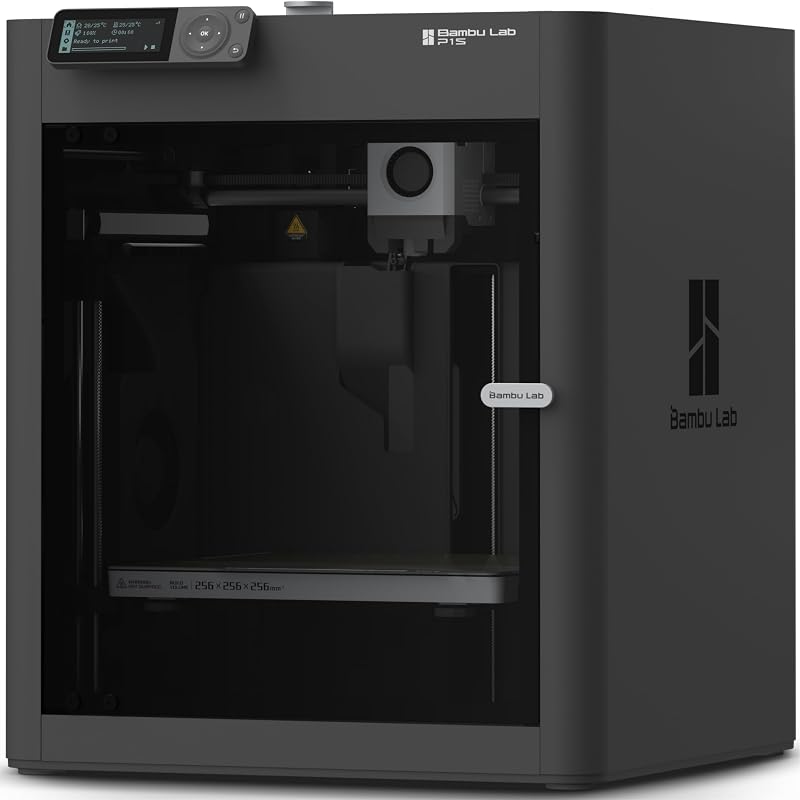
MakerWorld Model Library caters to makers who prioritize multi-color fabrication and plug-and-play setup over assembling a DIY kit, providing a ready-to-use Bambu Lab P1S Combo with automatic bed leveling and integrated AMS multi-color filament feeding right out of the box when evaluating prusa core one vs bambu lab p1s.

FLASHFORGE Adventurer 5M 3D Printer suits makers searching for a lightweight, accessible CoreXY platform with a 220x220x220mm build area, featuring a 280°C direct extruder, quick-swap 3S detachable nozzle, and automatic bed leveling without the assembly commitment of a full kit.
Beginner-Friendly Ecosystem with MakerWorld Model is aimed at creators who want an enclosed, high-speed Bambu Lab P1S machine ready to print immediately, offering access to an extensive model library without requiring manual frame construction or component wiring.
FAQ 214 words
What makes the Prusa CORE One DIY kit assembly accessible for builders?
The kit features a completely solder-free wiring setup, eliminating electrical fabrication risks. PRUSA includes full-scale 1:1 hardware templates for rapid part identification alongside a comprehensive photographic guide detailing every assembly phase step by step.
How does the Prusa CORE One enclosure temperature management function?
The enclosed chamber actively controls temperatures up to 55°C. It integrates an automatic top vent that regulates airflow dynamically, ensuring standard filaments like PLA stay crisp while engineering filaments like ASA, Nylon, and Carbon Fiber retain high ambient heat.
Can the Prusa CORE One run completely disconnected from internet networks?
Yes. The machine supports 100 percent offline operation with fully local data processing. It includes a physically removable Wi-Fi module, allowing sensitive educational and corporate facilities to enforce an air-gapped security protocol.
What engineering materials can the Prusa CORE One process effectively?
Thanks to its active 55°C chamber and controlled venting, the printer is designed to handle Carbon Fiber composites, Nylon, ASA, and PC-Blend alongside standard production filaments like PLA and PETG.
Why is the all-steel exoskeleton frame beneficial for CoreXY printing?
High-speed CoreXY kinematics generate significant directional momentum. The all-steel exoskeleton frame provides heavy structural rigidity that absorbs high-frequency vibrations, preventing ghosting and mechanical flex during rapid print maneuvers.
The other listings this review names
-

Bambu Lab P1S Combo, P1S 3D Printer and AMS, Multi-Color 3D Printing
8.4/10 Our score 6 spec fields
-

-
Bambu Lab P1S 3D Printer, Ready-to-Use FDM 3D Printer
9.0/10 Our score 6 spec fields


