Creality WiFi Box 2.0 Review: Wireless Control for Maker Rigs
Julia Ellery 2 Oct 2026 10 min read ASIN B0B5JMG9NK
This product against the Tools & Outdoors median
| Figure | This product | Category median | Where it sits |
|---|---|---|---|
| Our score Our score, out of 10. | 7.4/10 | 9.0/10 n=159 | 18% lower than the median |
| Spec fields published How many attributes the seller fills in on the listing. | 11 | 5.0 n=159 | 120% more than the median |
Medians are taken across the 159 published reviews in Tools & Outdoors; n on each row is how many of them publish that figure. The notch on every bar marks the median, so a fill reaching past the notch sits above it. Scores are out of 10, based on listed specifications and buyer feedback.

- Brand
- Sain Smart
- Our score
- 7.4/10
- Spec fields
- 11 attributes on the listing
As Amazon Associates, we earn from qualifying purchases. This means we may receive a small commission at no extra cost to you if you click through and make a purchase.
Managing desktop 3D printers often involves an endless cycle of transferring sliced files onto memory cards, walking them to your machine, and manually starting the job. For makers looking to modernize this routine, the Creality WiFi Box 2.0 functions as a dedicated bridge that introduces wireless networking, cloud slicing, and remote status tracking to rigs that lack factory wireless modules. Also known as the Creality Smart Kit 2.0 with Bluetooth, this revision resolves early configuration headaches by combining an onboard MIPS processor, dual network connectivity, and streamlined mobile Bluetooth pairing into a pocket-sized external enclosure. If you own an entry-level machine and want remote oversight without configuring a standalone computer, this unit offers an accessible path to untethered printing.
This performance assessment explores the real-world utility, network stability, and software features of the Creality WiFi Box 2.0 3D printer wireless system. Across this guide, we evaluate the onboard processing hardware, explain the simplified Bluetooth setup flow, analyze cloud slicing and real-time control, and discuss how the device operates on popular rigs like the Ender 3. We also examine the trade-offs of using cloud-based mobile control, compare it with alternative fabrication accessories, and help you determine whether this dedicated wireless upgrade fits your workshop.
What You Get With the Creality WiFi Box 2.0 181 words

The Creality WiFi Box 2.0 is an external network adapter designed to connect your 3D printer’s USB control interface directly to local networks and cloud services. Manufactured by SainSmart under model number 506506270, the physical enclosure measures 64 by 90 by 20 millimeters (2.51 by 3.54 by 0.78 inches) and weighs 0.21 kg. Built in a black polylactic acid casing, it contains the necessary processing hardware, wireless radios, and physical ports to upgrade your machine workflow.
- Compact black polylactic acid enclosure weighing 0.21 kg with integrated status indicator lights
- Embedded MIPS24KEc processor running at a 580MHz main frequency
- Internal memory configuration consisting of 128MB DDR2 RAM and 16MB flash storage
- Single-band 2.4GHz IEEE 802.11b/g/n 1T1R wireless radio for local network integration
- Fast 100M Ethernet RJ45 port for reliable hardwired local network connections
- Integrated Bluetooth module designed for rapid device pairing and network credential handoff
- External TF card slot supporting FAT32 and exFAT storage formats for local file caching
- Micro USB power input port accepting 5V and 2.4A DC electrical input
- Full integration with the Creality Cloud mobile app, model library, and cloud slicing engine
Key Specifications 138 words
Attribute Specification Detail
- Brand & Manufacturer
- SainSmart
- Model Number
- 506506270
- SoC Processor
- MIPS24KEc at 580MHz Main Frequency
- Memory & Storage
- 128MB DDR2 RAM, 16MB Flash ROM
- Wireless Standards
- IEEE 802.11b/g/n (2.4GHz, 1T1R) and Bluetooth Module
- Wired Network Interface
- 10/100M Fast Ethernet (RJ45)
- Power Requirements
- 5V / 2.4A Micro USB Input
- Supported Card Formats
- TF Card slot supporting FAT32 and exFAT
- Dimensions & Weight
- 64 x 90 x 20 mm (2.51 x 3.54 x 0.78 inches), 0.21 kg
- Operating Temperature
- -20°C to 60°C
Fields the seller filled in on the Amazon listing (10)
- Product Dimensions
- 2.51"D x 3.54"W x 0.78"H
- Item Weight
- 0.21 kg
- ASIN
- B0B5JMG9NK
- Item model number
- 506506270
- Best Sellers Rank
- #49,779 in Industrial & Scientific (See Top 100 in Industrial & Scientific) #857 in 3D Printer Accessories
- Date First Available
- July 1, 2022
- Manufacturer
- SainSmart
- Brand
- SainSmart
- Material
- Polylactic Acid
- Color
- Black
Hardware Architecture and Network Connectivity 251 words
The internal engineering behind the Creality WiFi Box 2.0 specs relies on a dedicated MIPS24KEc system-on-chip operating at a 580MHz main frequency, supported by 128MB of DDR2 memory and 16MB of onboard flash storage. While these resources are lean compared to desktop computers, they are well matched to the demands of an embedded communications relay. The processor handles incoming print files, manages USB serial communications with your printer’s mainboard, and reports machine status to cloud endpoints without generating excess heat. Drawing power through a 5V/2.4A micro USB port, the unit maintains modest power consumption during extended fabrication sessions.
Network reliability is addressed through two distinct communication pathways: a 2.4GHz IEEE 802.11b/g/n Wi-Fi radio utilizing a 1T1R antenna setup, and an RJ45 port delivering 100M Fast Ethernet. The wireless interface provides convenient cord-free placement in most home workshops. However, environments with congested 2.4GHz frequencies or high-density wireless networks, such as those optimized with a unifi u6 pro access point, benefit greatly from the hardwired Ethernet port. Using an Ethernet cable provides an uninterrupted data link that prevents packet dropouts during large file transfers.
The unit features an operating temperature range of -20°C to 60°C, making it capable of running in garages, workshops, and basements where ambient conditions fluctuate. Its lightweight polylactic acid shell provides passive cooling without internal fans. When setting up your fabrication area, keep the device mounted outside any heated printer enclosures to avoid exceeding its rated thermal boundaries and to maintain uninterrupted wireless performance.
Setup Process and Bluetooth Pairing Configuration 258 words
Initial configuration on early wireless print adapters was notoriously cumbersome, often requiring users to connect to ad-hoc networks and navigate manual browser interfaces. The Creality WiFi Box 2.0 setup experience eliminates those hurdles through an onboard Bluetooth module. Known as the Creality Smart Kit 2.0 Bluetooth system, this feature allows your mobile device to detect the adapter automatically inside the Creality Cloud application. The app immediately identifies the box, requests your local Wi-Fi password, and hands off the credentials over Bluetooth in moments, avoiding manual network switches on your smartphone.
Once paired, the device connects to your local network and registers with your Creality Cloud profile. Inserting a compatible TF card into the expansion slot is essential for reliable operation. The firmware supports both FAT32 and exFAT partition formats, giving you broad compatibility with different card capacities. This card acts as a local buffer for incoming print files. When a job is dispatched, the entire G-code file is saved directly to the card before printing begins, ensuring that temporary Wi-Fi disconnects do not halt nozzle movement or ruin active prints.
Physical installation requires running a standard USB data cable from the adapter’s host port to the controller board on your 3D printer. Certain printer mainboards draw power directly from the 5V line of the USB cable, keeping the printer screen backlit even when main power is switched off. To avoid this behavior, makers often use a data-only USB cable or tape over the 5V pin inside the connector, allowing clean serial communication while preserving independent power management for the printer.
Cloud Slicing and Real Time Control Features 233 words
A key aspect of this Creality wireless printing upgrade is its close integration with the Creality Cloud platform, enabling Creality WiFi Box 2.0 cloud slicing directly from your smartphone or browser. Instead of sitting at a dedicated computer running slicer software, you can select 3D models, apply preset material profiles, adjust infill or layer heights, and generate machine instructions via remote servers. The cloud engine slices the model and transmits the file directly to your connected box, providing a straightforward way to start prints on the fly.
Beyond file preparation, Creality WiFi Box 2.0 real time control provides continuous management over active machine operations. Users can monitor hotend and bed temperatures, adjust print speeds, tune extrusion multipliers, and manually jog axes before beginning a job. If a print begins to fail or lifts from the build plate, you can pause or cancel the job instantly through the app. The Creality WiFi Box 2.0 remote monitoring interface displays live print progress, elapsed time, and estimated completion times so you always know the current state of your rig.
The companion platform also connects directly to the Creality Cloud community repository, where users share downloadable models, printing tips, and troubleshooting advice. While advanced machines like the creality sparkx i7 3d printer often rely on desktop slicers for complex custom supports, the ability to select, slice, and print standard models entirely from a phone makes everyday fabrication practical and accessible.
Performance on Ender 3 and Workshop Rigs 230 words
Connecting the Creality WiFi Box 2.0 for Ender 3 printers and similar open-frame bedslingers resolves the common inconvenience of swapping micro-SD cards back and forth. Repeatedly inserting cards into standard mainboards can cause mechanical wear on the slot over time. By acting as an external USB serial bridge, this unit modernizes entry-level machines, allowing you to dispatch sliced models directly from your workstation or mobile device without touching a physical card.
For makers operating multiple printers, the system offers an organized multi-rig management workflow. Multiple WiFi Box adapters can be registered to a single Creality Cloud user profile, allowing you to supervise multiple machines from a unified dashboard. You can check the availability of each printer, monitor active print jobs, and send new tasks to whichever machine is idle. While advanced systems like the creality k1 max 3d printer come with integrated network hardware from the factory, these external boxes offer a practical way to bring legacy rigs into a centralized wireless workflow.
When running prints through an external adapter, users should be mindful of serial communication constraints. The 580MHz MIPS processor handles standard printing speeds and motion commands reliably. However, fabricators running specialized high-speed firmwares with dense micro-movements on complex curves should ensure their slicer resolution settings do not overwhelm serial buffers. For everyday maker projects, functional replacement parts, and decorative models, the box maintains steady serial communication and dependable execution.
Creality WiFi Box 2.0 Pros and Cons 55 words
Pros
Pros
- Bluetooth module for fast network pairing
- Dual 2.4GHz Wi-Fi and 100M Ethernet ports
- Remote cloud slicing through mobile app
- Real-time machine monitoring and axis control
- Onboard TF card slot for local file caching
Cons
- Requires Creality Cloud ecosystem for remote access
- Micro USB power connection instead of USB-C
- Limited to 2.4GHz Wi-Fi bands
Is the Creality WiFi Box 2.0 Worth It 190 words
Determining whether the Creality WiFi Box 2.0 is worth it depends largely on your current hardware and how you prefer to manage your printing workflow. If you operate standard Creality machines such as the Ender 3 or CR-10 series that lack built-in networking, this adapter removes the daily hassle of physical memory cards. The addition of Bluetooth configuration resolves earlier setup frustrations, and the combination of cloud slicing with remote monitoring delivers modern connected convenience without requiring you to assemble a custom mini-computer server.
On the other hand, makers who prefer entirely local network workflows without cloud accounts may find the software environment somewhat restrictive. The device relies on the Creality Cloud mobile and web interface for slicing and remote monitoring, which may not satisfy users who require private, offline network control or specialized third-party camera plugins. If you are comfortable working inside the Creality app, the hardware provides an easy, plug-and-play wireless bridge.
For workshop hobbyists managing multiple classic rigs, the box delivers real productivity gains. It lets you monitor prints from anywhere, manage print queues across multiple machines, and keep older reliable printers working effectively in a modern wireless environment.
Other Options to Consider 153 words
3D Printer WiFi Box Plug suits makers who want an alternative plug-and-play adapter featuring an SD card slot and an automatic file refresh adapter for 3D printers, providing a simple hardware-driven file transfer method without relying on a proprietary cloud mobile app.

Multi Color 3D Printer Filament suits fabricators looking to upgrade print quality through material conditioning rather than wireless adapters, offering a multi-color filament dryer box designed for rigs like the Anycubic ACE Pro for Kobra 3 Max (excluding Anycubic Kobra S1 and Kobra X) to keep spools protected from ambient moisture.
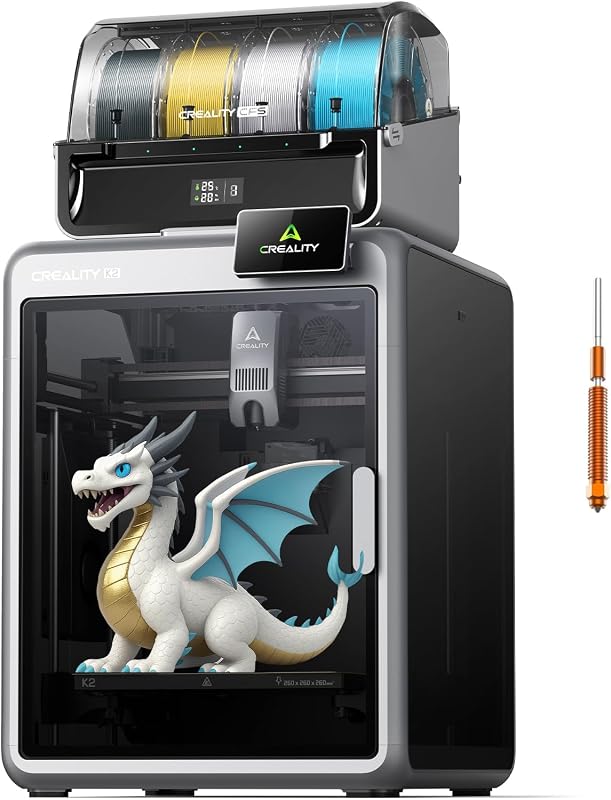
CrealityHigh-Speed 600mm s suits makers ready to invest in a complete modern platform rather than retrofitting an older unit, providing a K2 Combo 3D printer featuring 600mm/s print speeds, smart auto leveling, quiet printing, dual AI cameras, a direct drive extruder, a 260x260x260mm build volume, and multicolor printing with CFS.
FAQ 229 words
How does Bluetooth improve the initial configuration?
The integrated Bluetooth module in the Creality Smart Kit 2.0 allows the Creality Cloud mobile app to detect the adapter automatically. This lets you transfer local Wi-Fi network credentials to the device without having to connect manually to a temporary ad-hoc Wi-Fi network.
What memory card format is required for the expansion slot?
The TF card slot supports both FAT32 and exFAT file systems. Installing a formatted card provides local storage where the box caches full G-code files prior to execution, preventing print failures if your wireless connection drops during printing.
Can the unit be connected using an Ethernet cable?
Yes, the box includes a 100M Fast Ethernet RJ45 port alongside its 2.4GHz Wi-Fi radio. This allows you to hardwire the unit directly to your network router or switch for maximum connection stability in crowded wireless environments.
What type of power connection does the device use?
The adapter is powered through a micro USB port requiring a 5V and 2.4A DC power supply. Using a reliable external power adapter ensures steady operation during multi-hour printing jobs.
Can you slice 3D models remotely with this device?
Yes, through integration with the Creality Cloud platform, you can slice models remotely on cloud servers using your smartphone or web browser and send the resulting G-code directly to your connected printer without using a local computer slicer.
The other listings this review names
-

3D Printer WiFi Box Plug and Play with SD Card Slot - Automatic File Refresh Adapter for 3D Printers
8.8/10 Our score 3 spec fields
-

Anycubic ACE Pro for Kobra 3 Max 3D Printer
9.2/10 Our score 4 spec fields
-
Creality K2 (A) Combo 3D Printer, Multicolor Printing with CFS
8.6/10 Our score 5 spec fields